
Wanhang专注散热风扇生产厂家


4News -> Company
Operational Condition Acoustic Inspection Normal: Uniform wind sound, no abnormal friction noise, jitter or piercing howling. Abnormal: Clicking impeller collision sound (foreign object jamming), humming low-frequency jitter (bearing oil shortage / dust accumulation imbalance), irregular speed fluctuation (loose wiring, drive board failure).
Functional Signal Inspection
The PLC in the control cabinet checks the fan speed feedback, and no shutdown fault alarm is triggered; the temperature-control linked fans can automatically start/stop and adjust speed according to temperature changes. II. Regular Cleaning and Maintenance
1. Short-term: Every 7 to 15 days (shorten to 7 days for urea dust workshops)
Power off and shut down the equipment! It is strictly forbidden to perform cleaning operations with electricity on.
Use low-pressure compressed air (0.2–0.3MPa) to blow off dust from the impeller, frame and heat dissipation filter screen; remove stubborn dust with a soft brush.
If urea crystals or oil stains are attached: wipe the blades with a lint-free cloth dipped in a small amount of absolute alcohol, and power on the equipment again after it is fully dried.
It is forbidden to directly flush ordinary fans with an IP rating below IP54 with water, as this will burn out the internal drive circuit board. 2. Medium-term: In-depth maintenance every 3 months
Disassemble the fan, and clean the accumulated dust in the dead corners of the frame and the gaps of the bearing;
Check the impeller for dust accumulation that causes unbalance, and check the blades for cracks. Replace the fan immediately if the blades are deformed;
Inspect the insulating layer of the power cord and plug. Replace them immediately if there is aging cracking, hardening or skin breakage; For moisture-proof models, check the sealing rubber strip. Replace it if it is hardened or fallen off, to prevent water vapor from corroding the circuit board.
3. Long-term: 6-month Special Maintenance for Bearings (Distinguish between Double Ball Bearing / Oil-Impregnated Bearing) Oil-Impregnated Bearing Fan (Low-cost Model)
Peel off the oil seal sticker on the back, drip a small amount of special high-temperature bearing lubricating oil, and re-seal the sticker. Long-term oil shortage will cause abnormal noise, speed drop and heat dissipation failure.
Double Ball Industrial Fan (Standard Configuration for Urea Equipment)
Replenish high-temperature grease once every 6 months under normal working conditions; it is recommended to replenish oil every 3 months for 24-hour non-stop operation.
If there is continuous abnormal noise and obvious speed reduction, the bearing is irreparably worn and should be replaced directly.
III. Electrical System Maintenance
Power off and fasten the wiring terminals to prevent virtual connection from generating heat and burning the drive board;
Check that the PWM speed regulation wire and speed measurement signal wire are free of wear, extrusion and sheath breakage;
Measure the input voltage (DC 12/24V). If the voltage fluctuation exceeds ±10V, it will accelerate the damage of the fan, so troubleshoot the power supply fault;
Blow and clean the dust on the surface of the drive circuit board to avoid short circuit caused by dust accumulation.
IV. Special Working Conditions
The workshop is exposed to urea dust, water vapor and slightly corrosive volatile gases, so additional maintenance items are added as follows: Increase the purging frequency to once a month to prevent the urea powder from adhering to the impeller and caking, which will cause dynamic balance failure;
Prioritize the selection of IP54 moisture-proof fans, inspect the waterproof rating every half a year, and disassemble and dry the fans immediately once water ingress occurs;
Avoid direct blowing of the fan towards the urea mist in the reactor and filling area, as long-term intrusion of the mist will corrode the circuit solder joints.
V. Maintenance for Long-term Storage after Shutdown
Cut off the power supply and remove the fan or disconnect the power supply;
Thoroughly clean the dust crystals on the blades;
Replenish lubricating oil for the bearings, and wrap the fan with a dust-proof and moisture-proof plastic film;
Store in a dry and ventilated place, and stacking in open-air areas or humid corners is prohibited.
VI. Prohibited Operations Disassembly or purging while the equipment is energized;
Directly blowing the drive circuit board at close range with a high-pressure air gun;
Flushing ordinary non-waterproof DC fans with water or high-pressure water guns;
Using engine oil or ordinary grease as a substitute for special high-temperature bearing oil;
Blocking the air inlet and outlet for forced long-term operation;
Forcibly supplying power with mismatched voltage (a 24V fan connected to a 36V power supply will burn out immediately). VII. Pre-diagnosed Maintenance and Replacement Standards
In case of the following conditions, direct replacement is required without repair to avoid burning out the entire set of electronic control equipment:
Persistent abnormal noise and severe vibration with no improvement after oil replenishment;
No rotation speed feedback and continuous RD fault alarm;
Cracked fan blades and deformed frame;
Internal circuit board corrosion due to water ingress and burnt black circuits;
Significant drop in rotation speed, leading to frequent high-temperature protection of the equipment caused by substandard heat dissipation.
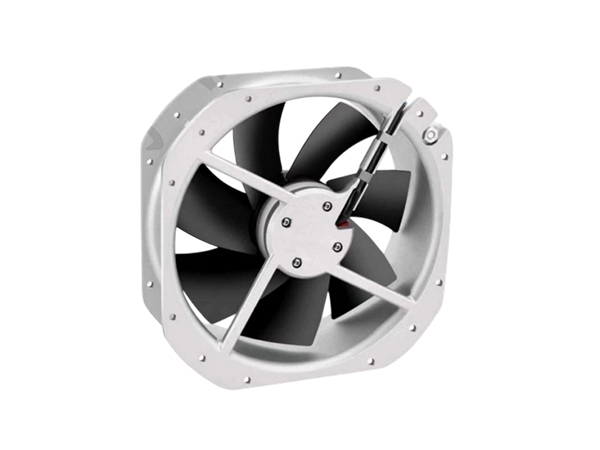
The cooling fan manufacturer states that DC fans are powered by direct current voltage (mainly DC 12V/24V/48V), and drive the impeller to supply air through a Brushless Direct Current (BLDC) motor, which is different from household 220V Alternating Current (AC) fans. Features: low-voltage safety, simple speed regulation, low noise, high energy efficiency, widely used for equipment heat dissipation.
Operational Condition Acoustic Inspection Normal: Uniform wind sound, no abnormal friction noise, jitter or piercing howling. Abnormal: Clicking impeller collision sound (foreign object jamming), humming low-frequency jitter (bearing oil shortage / dust accumulation imbalance), irregular speed fluctuation (loose wiring, drive board failure).
Functional Signal Inspection
The PLC in the control cabinet checks the fan speed feedback, and no shutdown fault alarm is triggered; the temperature-control linked fans can automatically start/stop and adjust speed according to temperature changes. II. Regular Cleaning and Maintenance
1. Short-term: Every 7 to 15 days (shorten to 7 days for urea dust workshops)
Power off and shut down the equipment! It is strictly forbidden to perform cleaning operations with electricity on.
Use low-pressure compressed air (0.2–0.3MPa) to blow off dust from the impeller, frame and heat dissipation filter screen; remove stubborn dust with a soft brush.
If urea crystals or oil stains are attached: wipe the blades with a lint-free cloth dipped in a small amount of absolute alcohol, and power on the equipment again after it is fully dried.
It is forbidden to directly flush ordinary fans with an IP rating below IP54 with water, as this will burn out the internal drive circuit board. 2. Medium-term: In-depth maintenance every 3 months
Disassemble the fan, and clean the accumulated dust in the dead corners of the frame and the gaps of the bearing;
Check the impeller for dust accumulation that causes unbalance, and check the blades for cracks. Replace the fan immediately if the blades are deformed;
Inspect the insulating layer of the power cord and plug. Replace them immediately if there is aging cracking, hardening or skin breakage; For moisture-proof models, check the sealing rubber strip. Replace it if it is hardened or fallen off, to prevent water vapor from corroding the circuit board.
3. Long-term: 6-month Special Maintenance for Bearings (Distinguish between Double Ball Bearing / Oil-Impregnated Bearing) Oil-Impregnated Bearing Fan (Low-cost Model)
Peel off the oil seal sticker on the back, drip a small amount of special high-temperature bearing lubricating oil, and re-seal the sticker. Long-term oil shortage will cause abnormal noise, speed drop and heat dissipation failure.
Double Ball Industrial Fan (Standard Configuration for Urea Equipment)
Replenish high-temperature grease once every 6 months under normal working conditions; it is recommended to replenish oil every 3 months for 24-hour non-stop operation.
If there is continuous abnormal noise and obvious speed reduction, the bearing is irreparably worn and should be replaced directly.
III. Electrical System Maintenance
Power off and fasten the wiring terminals to prevent virtual connection from generating heat and burning the drive board;
Check that the PWM speed regulation wire and speed measurement signal wire are free of wear, extrusion and sheath breakage;
Measure the input voltage (DC 12/24V). If the voltage fluctuation exceeds ±10V, it will accelerate the damage of the fan, so troubleshoot the power supply fault;
Blow and clean the dust on the surface of the drive circuit board to avoid short circuit caused by dust accumulation.
IV. Special Working Conditions
The workshop is exposed to urea dust, water vapor and slightly corrosive volatile gases, so additional maintenance items are added as follows: Increase the purging frequency to once a month to prevent the urea powder from adhering to the impeller and caking, which will cause dynamic balance failure;
Prioritize the selection of IP54 moisture-proof fans, inspect the waterproof rating every half a year, and disassemble and dry the fans immediately once water ingress occurs;
Avoid direct blowing of the fan towards the urea mist in the reactor and filling area, as long-term intrusion of the mist will corrode the circuit solder joints.
V. Maintenance for Long-term Storage after Shutdown
Cut off the power supply and remove the fan or disconnect the power supply;
Thoroughly clean the dust crystals on the blades;
Replenish lubricating oil for the bearings, and wrap the fan with a dust-proof and moisture-proof plastic film;
Store in a dry and ventilated place, and stacking in open-air areas or humid corners is prohibited.
VI. Prohibited Operations Disassembly or purging while the equipment is energized;
Directly blowing the drive circuit board at close range with a high-pressure air gun;
Flushing ordinary non-waterproof DC fans with water or high-pressure water guns;
Using engine oil or ordinary grease as a substitute for special high-temperature bearing oil;
Blocking the air inlet and outlet for forced long-term operation;
Forcibly supplying power with mismatched voltage (a 24V fan connected to a 36V power supply will burn out immediately). VII. Pre-diagnosed Maintenance and Replacement Standards
In case of the following conditions, direct replacement is required without repair to avoid burning out the entire set of electronic control equipment:
Persistent abnormal noise and severe vibration with no improvement after oil replenishment;
No rotation speed feedback and continuous RD fault alarm;
Cracked fan blades and deformed frame;
Internal circuit board corrosion due to water ingress and burnt black circuits;
Significant drop in rotation speed, leading to frequent high-temperature protection of the equipment caused by substandard heat dissipation.


-
About
Company Profile Corporate Culture Corporate Image Honors & Certifications Partners Video Center -
Product
Axial Fan Blower Fan Graphics Card Fan Heat Sink Module AC Fan More>> -
Solutions
Consumer Electronics Communication Equipment Industrial Control New Energy Equipment Home Appliance Applications Automotive Electronics LED & Lighting Medical Devices -
News
Company Industry FAQ -
Contact Us
Contact Information
Dongguan Wanhang Electronic Technology Co., Ltd. 【Admin】
-
Hotline
+86 139 2557 5658
Consultation Hotline (Mr. Cai)
-
Consult
-

TOP